
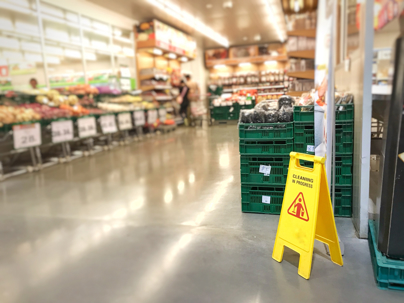
Unfortunately, slip and falls in grocery stores happen much more frequently than you might think. You’re just going about your business at Publix, and next thing you know, bam, you are flat on your back.
Just about every single day, somebody somewhere in Florida slips and falls while shopping at a grocery store. Our office very frequently represents clients who were injured after they slipped and fell walking around their local Publix, Aldi, Walmart, Target, or some other food market.
Whether from spilled liquids or dropped foods, or hardwood floors that are still wet due to a recent mopping, or any number of other causes, slip and falls are extremely common occurrences at grocery stores all throughout Florida.
What Do I Have to Prove?
Slip and fall cases at grocery stores are considered premises liability cases. The owners of grocery stores, like most premises and business owners in Florida, have a duty to their customers to maintain their premises in a reasonably safe condition and to warn customers of any concealed dangers.
The duty to maintain the premises in a reasonably safe condition typically means that a grocery store must:
- Regularly inspect the walkways and aisles in the store to make sure the walking areas are safe for customers
- Clean up spills within a reasonable time
- Fix any dangerous conditions that could cause a person to fall or otherwise be injured at the premises
Basically, the business must make sure the store is in a reasonably safe condition for customers.
The duty to warn usually means that when store employees become aware of a non-obvious danger at the premises, they must do things like:
- Put up a sign or cone (for example, a yellow cone telling people that the floor is wet)
- Block off spills so that customers can know not to walk in the area
- Provide any other visual warnings to let people know of a hazard in the area
In short, the business needs to warn you of hazards in the store that are not open and obvious.
If you are injured because the grocery store failed to maintain their premises in a reasonably safe condition or failed to warn of a concealed danger at the store, then the business may be legally responsible for your injuries. But as we explain below, there is also one other important wrinkle in slip and fall cases.
What is a Transitory Foreign Substance?
Slip and falls in grocery stores are often caused by a person slipping on a transitory foreign substance that is present on the store’s floor. A transitory foreign substance is basically any object on the floor that doesn’t belong there. Some examples of transitory foreign substances that are frequently found in grocery stores include:
- Spilled water or soda
- Rainwater that is trekked in from the outside of the store
- Dropped grapes or blueberries or any other foods, condiments, etc.
These are just a few examples of transitory foreign substances that we commonly see cause people to slip and fall.
When your slip and fall at a grocery store involves a transitory foreign substance, there is a specific Florida law that applies: Florida Statutes § 768.0755.
What Do You Have to Prove Under Florida Statutes § 768.0755?
The statute requires that a person who slips and falls on a transitory foreign substance at a business must prove that the business had actual or constructive knowledge of the dangerous condition and had a chance to remedy it. That means that you need to show either that an employee of the business actually knew about the dangerous condition (actual knowledge), or that they should have known about it (constructive knowledge).
The way to prove constructive knowledge is to show either that:
- The dangerous condition existed for long enough that the business should have known of it (for example, if the spilled liquid had been on the floor for, let’s just say, 15 minutes before your fall, that oftentimes will be enough to prove constructive knowledge), or
- The condition occurred with regularity (meaning that the condition happened frequently enough that the business should have known about it)
If you slipped on a transitory foreign substance but can’t show that the business had actual or constructive knowledge, then you lose. This issue of whether the business had knowledge (and most of the time, the question is whether they had constructive knowledge) of the dangerous condition is the most frequently litigated issue in slip and fall cases. In other words, that’s the thing we most often fight about in court – whether the business should have known about the dangerous condition under the circumstances.
Call Our Office Today for a Free Consultation
If you’ve been injured in a slip and fall at any grocery store in Broward, Palm Beach, or anywhere else in Florida, call our office today at (954) 833-1440 for a free consultation. We have more than 40 years of experience representing clients in slip and fall cases.